Welcome to 8 Bit Horse

8 Bit Horse is a website dedicated exclusively to 2D video games for all systems, old and new.

Lessons in 2D Game Design

We delve into the design lessons learned from classic 2D video games.

Picks of the Decade

Our picks of the most memorable games from the previous decade.

A Celebration of 2D

Our list of notable 2D video games.

Showing posts with label Nintendo. Show all posts

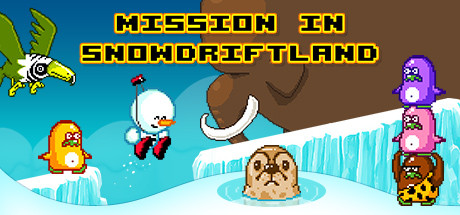
Mission in Snowdriftland

A game by Extra Toxic for browser, originally released in 2006, and remastered by Tons of Bits for PC in 2021, and released for Switch in 2024.
The mid-2000’s were something of a transformative period for Nintendo, with the launch of the Nintendo DS in 2004 and the Wii in 2006. The Nintendo DS represented yet another handheld console success for the company, while the Wii reignited the fires of Nintendo’s home console popularity after being overshadowed (yet still profitable) for the previous two generations. This part of Nintendo’s history is much discussed and very well documented, but less well known are the adventures of a certain snowman named Chubby.
In 2006, to celebrate their new systems and upcoming games, Nintendo offered a playable advent calendar entitled UPIXO in Action: Mission in Snowdriftland, with one level available for play each day from December 1-24, counting down the days to Christmas. The Flash-based game was a platformer starring a snowman named Chubby Snow who wore red shoes and a bellboy cap. Chubby traveled through four (mostly snowy) themed areas bopping enemies on the head, collecting snowflakes, and searching for hidden hearts that permanently extended his life meter.


Boxboy + Boxgirl

A game by HAL Laboratory for Switch, originally released in 2019.
Boxboy + Boxgirl is part of a long running series of puzzle-platformers starring the box-shaped Quby and several of his similarly box-shaped companions. The prior series consists of Boxboy, Boxboxboy, and Bye-Bye Boxboy, all of which originated on the 3DS handheld, which was well-suited for the bite-sized challenges the game had to offer, as well as the simple visuals. The visuals here are faithful to the original series, so the upgrade to a higher resolution simply allows for somewhat smoother lines in an otherwise black- and white-dominated orthogonal world.


But the world was not always so dark… One day, a big inky blob came down from the skies and covered the colorful box world with goo, rendering it black and immobilizing many of Quby’s friends. As such, he sets out to rescue them, along with Qucy. In 1P, the player is free to swap between these two characters at will – though they are functionally identical – but players can also team up for 2P cooperative play in a dedicated mode, or fully solo players can also play this mode alone by swapping control between the two characters.


Bye-Bye Boxboy

A game by HAL Laboratory for 3DS, originally released in 2017.
Qbby and pals have returned for one more adventure in the Boxboy universe, this time entitled Bye-Bye Boxboy. This is the third game in the series, following Boxboy and Boxboxboy, each of which features Qbby using his box-extending powers to create shapes that allow him to navigate levels and solve environmental puzzles. As before, the visual design is quite minimal, with simple black and white backgrounds, boxy environments, and Qbby himself appearing as a box with legs. The story is also minimal, tasking Qbby to save a series of planets, but a new element is added in the form of Qbabies that introduce several new block types that significantly impact gameplay.


As in the previous games, Qbby has a low 1x jump and the ability to extend boxes outward from his body to create platforms, shields, and hooks, and these tools allow him to cross gaps, avoid being killed by electrical beams, and pull himself up to higher ledges. The length of these box chains is dictated by a counter that allows for shapes between three and eight blocks in length, but most levels limit this number to four or five blocks. In this regard, the game is more like the original Boxboy, which offered similar puzzle designs and restrictions, rather than Boxboxboy, which allowed players to create two smaller stacks of blocks.


Boxboy / Boxboxboy

Games by HAL Laboratory for 3DS, originally released in 2015 and 2016, respectively.
Boxboy and Boxboxboy – which are technically named BOXBOY! and BOXBOXBOY! – are a pair of puzzle platformers starring a little square fellow named Qbby. There’s not much to the little guy, as he is made up of a rounded box with two legs and two eyes and nothing else, although he does exude a bit of personality in his smooth movements and cute idle animations. The games are presented with similarly minimal visuals consisting of simple black and white designs with occasional grey highlights in the original game, and with the addition of bits of green in the sequel.


There’s also not much to the story, which involves the player unlocking a series of doors across a largely featureless corridor and overcoming the challenges within, which clears paths that allow him to reach the next set of doors. At certain points, the player interacts with some mysterious machinery that triggers wordless cutscenes, revealing a square planet being restored and the occasional rescue of one of Qbby’s friends.


The Legend of Zelda 101

LESSONS IN 2D GAME DESIGN
A game by Nintendo for NES, originally released in 1986.
Looking at the history of gaming in general, a number of arcade and computer titles are immediately recognizable for their influence on the medium. However, while console gaming grew from the same basic nutrients as computer and arcade gaming, it managed to flower into something entirely different.

Early console games tended to mimic the quarter-driven sensibilities of the arcade, or simply offered conversions of the arcade experience on a smaller scale. But the NES managed to popularize home console gaming in a way that none of its forebears had, and it brought with it a slew of console-originated gaming experiences where high scores were no longer the primary goal. Rather than the endlessly-repeating screens of Pac-Man and Nintendo’s own Donkey Kong, games like Super Mario Bros. offered a variety of landscapes, new obstacles to overcome in each area, and clear progress toward an end goal.


Drill Dozer

A game by Game Freak for GBA, originally released in 2006.


CONTEXT
If you’ve never heard of Game Freak, that’s probably because you haven’t been on a decade-long quest to capture elemental animals to become the best trainer the world has ever known. That’s right, Game Freak is primarily known as the “second party” developer behind the core (i.e. handheld) games in the Pokémon series.


Wario Land 3

A game by Nintendo for GBC, originally released in 2000.

CONTEXT
Wario is an odd choice to be the star of a Nintendo game, given his greedy and power-hungry nature, a nasty habit of freely letting loose with his bodily functions, and his morbid obesity. Wario was obviously based on the character of Mario, the famous and somewhat portly plumber who travels the world collecting coins and grabbing powerups to defeat the evils of the land. Wario, on the other hand, is a character built on the same foundations, except that he grabs coins to line his pockets, and seeks power for personal gain.


Super Mario Bros. 101

LESSONS IN 2D GAME DESIGN
A game by Nintendo for NES, originally released in 1985.
People have a strong tendency to use Super Mario Bros. as a comparison when discussing any type of platforming game, and even side-scrolling action games in general. This is due, in part, to the fact that the original Super Mario Bros. has been experienced by more people than practically any other console game ever made, and is therefore easily relatable. But more than that, the game is tightly designed. It wasn’t successful just because it was technically superior to the other games on the market; it was a better designed game overall. At the time of its release it was a revelation, but even decades later, it still holds up.

We all understand what an important role Super Mario Bros. played in shaping the gaming landscape, and in revitalizing the U.S. game market, but the question is: how is it that a game created at the start of the NES era – with a relatively small team, small budget, and laughably simple hardware – could outshine many of the multi-million dollar blockbusters of today? The answer is in the game. And it’s been right in front of us the whole time.


Kid Icarus: Of Myths and Monsters

A game by Nintendo and Tose for GB, originally released in 1991.

CONTEXT
The original Kid Icarus and Metroid games share a common history. Both were developed by Gunpei Yokoi, father of the GameBoy (as well as the Game and Watch, VirtualBoy, and the WonderSwan). They shared the same game engine and both had scores composed by Hip Tanaka. Each of them had a followup on the original GameBoy, which were also developed by Yokoi, and again they shared the same game engine.


Metroid II: Return of Samus

A game by Nintendo for GB, originally released in 1991.


CONTEXT
The first two entries in the Metroid series are close cousins to the first two games in the Kid Icarus series. Both Metroid and Kid Icarus began their lives as NES games sharing the same game engine, and both were developed by Gunpei Yokoi and scored by Hip Tanaka. Their GameBoy sequels, Metroid II: Return of Samus and Kid Icarus: Of Myths and Monsters, also shared the same game engine and were produced by Yokoi.


Kid Icarus

A game by Nintendo for NES, originally released in 1987.


CONTEXT
In 1986 a pair of games was under development at Nintendo R&D1. Both games were produced by Gunpei Yokoi, and each shared the same game engine and featured music composition by Hirokazu “Hip” Tanaka. One of these games went on to become a multi-million selling cornerstone franchise for Nintendo, spread across generations of consoles with numerous sequels and spinoffs. The other became… little more than a footnote, without a new game the series for almost 20 years.