


A game by Tribute Games for PC, Linux, Switch, PS4, and Xbox One, originally released in 2020.
Panzer Paladin is an action platformer set in a world that is under siege by the occult forces of Ravenous, who has sent 10 weapon-shaped meteors hurtling toward Earth, each landing in a different country. Using these weapons as portals, hordes of demons pour forth, threatening all of mankind as the world’s armed forces fall before their might. Fortunately, a plucky android named Flame offers to step in and save the day, despite the fact that she was not built for war… but no matter, because she is able to pilot a hulking suit of robotic power armor called Grit.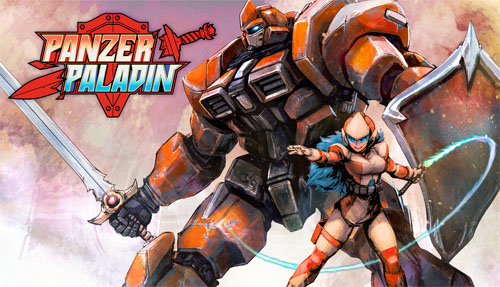
The game is modeled after 8-bit classics with numerous gameplay styles on offer, mixing mech combat with platforming, grappling, and the ability to hop in and out of the mech as the situation demands. The level structure is set up like the Mega Man X series, with a single level that the player must complete at the start, which doubles as a tutorial, followed by 10 levels that may be played in any order. Once all of these levels have been completed, the player gains access to the final gauntlet of six tougher levels that must be played in sequence.

All of Grit’s combat techniques are built around melee strikes, and while the mech suit is capable of punching, most of the game is spent wielding various sorts of weapons. Grit can attack to the left or right while standing, ducking, or jumping, with downward strikes possible while jumping, and upward strikes possible while standing or jumping. Attacking upward while jumping also gives Grit a bit of extra height to his 1.5x variable jump, and striking an enemy below causes a short hop, allowing him to bounce from one enemy to the next.

Grit can also perform a backstep to avoid attacks and has a shield that can block high or low projectiles as long as he is not attacking or jumping. Blocking just as an enemy strikes can temporarily stun them, allowing Grit to get in some free hits, even against enemies carrying shields. Otherwise, when fighting shielded enemies, players must alternate between high and low attacks in order to find an opening and cause damage.

With a button press, Flame can hop out of the mech and run around the environment. Her maximum jump height is the same as Grit’s, but she is somewhat less capable in combat. She is able to swing a whip to the left or right while standing or jumping, which has a longer range than Grit's attacks, but she cannot attack upwards or downwards and she cannot make use of any other weapons. She can also use her whip to latch onto grapple points and swing herself through the air, often over bottomless pits with multiple grapples required in succession.

Leaving the mech is optional for most of the game, but there are short areas in most levels where the player encounters passages that are too small for Grit to enter. Here, the player must hop out and complete a short platforming and/or grapple sequence, at the end of which is a teleporter that allows the player to summon Grit to his position. A few areas have alternate routes that allow the player to make progress through the level using Flame instead of Grit, which may allow the player to avoid some enemies and obstacles. Also, each level contains side paths for Flame – often hidden behind destructible walls – that lead to 1UPs or energy tanks that restore Grit’s health meter. In a nice touch, 1UP icons are specific to each geographical area, so for instance, the 1UP icon in Egypt is a scarab beetle.

Grit and Flame have separate health meters, and Grit is able to sustain quite a lot of damage, whereas Flame falls with just a few hits, and her health is not restored by re-entering the mech, as is the case in most other games with this mechanic. Each level contains a single energy tank to restore a small amount of Grit’s health meter, and there are some restorative canisters for Flame, but these are harder to find. The player begins the game with three lives, and losing them all returns him to the start of the level (with three lives restored), but he has infinite continues. Losing a single life returns the player to the most recent checkpoint… but there is a significant distance between them (there are only two per level), which can result in a lot of repeated play. Further complicating matters are numerous traps such as water and bottomless pits that will kill the player instantly.

The player is able to select between Easy, Normal, and Hard modes from the start and can change the difficulty level at any time during the game. It’s worth noting that the player is able to visit most levels in any order (and replay them). As a result, the difficulty curve remains relatively flat throughout most of the experience, but the difficulty level increases for the final six levels, offering tougher environmental challenges and more complex boss encounters. The game also features a speedrun mode, as well as a mode where you can design your own custom weapons, and a unique take on the boss rush formula via Tournament mode, which is locked to start. There’s also a remixed Classic mode that unlocks when the player completes the game, offering an additional challenge.

The primary aspect that sets this game apart from other genre entries is its weapons system. Throughout the game, you will encounter dozens of different melee weapon types, each of which may be added to your inventory to be used right away or held for later. Some weapons are simple swords of varying lengths and damage output, but there are also spears, hammers, staffs, and even some really odd weapons like a dead cat on a stick or a keytar. In addition, every boss you defeat grants a unique weapon that is more powerful than those you’ll find during regular play.

You can have four active weapons in his inventory at any given time and cycle through them with a button press. With fewer than four weapons equipped, any weapon recovered from a downed enemy or hidden behind breakable blocks will be immediately added to your cache of usable weapons. Anything beyond four is dropped into to your inventory, and you may equip these weapons from the pause menu. Every weapon has a different range, attack power, and durability.

Every time a weapon makes contact with an enemy or destructible object, it loses some durability, until it is eventually destroyed. While this kind of weapon system generally slows the pace of straightforward action games, here it is part of the overarching strategy. First of all, in order to activate a checkpoint, you need to give up one of your weapons. You get loads of them, so you’re not likely to put yourself at a disadvantage, but you can take the risk and skip a checkpoint if you want to hold onto your inventory. Generally, you’ll just equip the weapon with the least amount of durability, slam it down into the checkpoint, and move on… but there’s another use for weapons: magic spells.

Every weapon you encounter has a spell associated with it, and at any point you can choose to destroy an equipped weapon to unleash its spell. Spells come in several varieties, offering increased attack power, increased defense, or increased durability for your next equipped weapon (these effects are stackable), as well as small, medium, and large health restoration. There’s even a spell that temporarily grants the player wings, allowing him to bypass most environmental obstacles and enemies.

Offensive spells include lightning strikes and the ability to absorb HP from your enemies to restore a small amount to your mech. There’s even a blessing spell that grants slow health restoration over time, and this can be used to counteract being cursed (which slowly drains health). It takes a few seconds to break a weapon, so it can be risky to try during combat, but keeping an extra baseball bat on hand with a large health restoration spell can save you in a pinch.

Things start with a bang as a cool anime-style intro introduces the characters. Then you drop down into a level set in Canada where you learn the basic mechanics and encounter loads of different weapon types right out of the gate. You also learn that you can throw weapons across the screen to hit distant foes, although doing so causes you to lose the thrown weapon (you can pick it back up if you miss your target). Early on, it’s best to hold onto as many extra weapons as possible, because you have the option to melt down excess weapons between levels for small permanent health upgrades.

While you’re free to exit the mech and run around as you like – there’s a teleporter before each checkpoint so you won’t ever be stuck – the mech’s increased defense makes it safer to stay inside. Plus, you can’t pick up any of the cool weapons while playing as Flame… but in a nice touch, if the mech is destroyed, Flame automatically hops out to begin fighting on her own. Most Flame-specific challenges are very short, but there is one level late in the game where the player must rely almost entirely on Flame to navigate the area. Thoroughly exploring levels occasionally results in finding a durability powerup, which affects the current equipped weapon, and there are also powerful weapons tucked behind blocks that must be destroyed with certain weapon types – cutting, piercing, or impact – but given the abundance of weapons, you’ll almost always have something on hand to break it.

The player encounters many of the common enemy and weapon types throughout much of the game, which can make some of the action repetitive, but things are changed up from time to time with more powerful foes or tougher environmental challenges. Players will encounter exploding platforms, rolling rocks and cannon balls, conveyor belts, lasers that can be blocked with moving platforms, a moving train, and even the requisite mine cart and elevator sequences (both in the same level!), along with the traditional platforms that drop out, fall, or move back and forth.

The methods required for defeating enemies are generally clear based on their designs, with some impervious to attack from a certain direction and others using shields or other objects to block your attacks. Bosses offer somewhat more complex behaviors as well as some subversions to the established mechanics. For instance, when fighting Medusa, she is able to temporarily turn Grit to stone, requiring that you hop out and attack as Flame if you don’t want to remain stuck in place. Anubis has a powerful attack that can actually knock you out of the mech, but there are grapple points along the top of the arena so you can get back over to the mech while avoiding attacks.

However, some bosses are quite easy, even on a first playthrough, and particularly if you’ve cast attack or defense spells beforehand. Since most regular enemies fall with one or two hits from any weapon, it’s best to save boss weapons to fight other bosses, and doing so allows you to cause quite a bit of damage, to the point where it’s possible to stand still and just hammer the ATTACK button while absorbing any incoming damage. Of course, this won’t work for every encounter, and you’ll need to improve your combat skills by the time you face the bosses in the final six levels.

You’ll also fight a mysterious horseman several times throughout the game (every other level or so), and he’s introduced with a short musical theme. The horseman is a bit challenging the first time you face him, but he doesn’t change up his tactics, making him easy to defeat on subsequent encounters, and doing so grants a unique weapon each time. As you might expect, he eventually plays a role in the story.

Aesthetically, the game is done up in an 8-bit style with a bright and colorful palette, and a constantly upbeat soundtrack. Since each level takes place in a different country, there are lots of visual themes. That said, some of the backgrounds are overly busy with little to no negative space, which gives areas a somewhat crowded feel compared to the classics of the 8-bit generation. Character designs are cool, with badass player characters, stylish enemies, and wicked boss creatures. The game also features some nice cutscenes after every few levels, offering a bit more to the story and adding to the generally lighthearted atmosphere, and there’s an exciting introductory sequence as Flame and Grit are dropped into each new area.

2D CRED
Panzer Paladin was developed by Tribute Games, a studio based in Montreal, Quebec. The studio previously developed Ninja Senki DX, a Gameboy Color-style ninja actioner; Wizorb, a game that crosses the block breaking of Arkanoid with RPG elements; Mercenary Kings, a Metal Slug-inspired run-and-gun actioner with RPG stats and a crafting system; Curses ‘n Chaos, a colorful single-screen brawler; and Flinthook, a procedurally-generated grapple-based platformer.


