Welcome to 8 Bit Horse

8 Bit Horse is a website dedicated exclusively to 2D video games for all systems, old and new.

Lessons in 2D Game Design

We delve into the design lessons learned from classic 2D video games.

Picks of the Decade

Our picks of the most memorable games from the previous decade.

A Celebration of 2D

Our list of notable 2D video games.

Showing posts with label XBLIG. Show all posts

Xbox Live Indie Games

A 2D RETROSPECTIVE
Xbox Live Indie Games (XBLIG) launched on Microsoft’s Xbox 360 platform on November 19, 2008* as Xbox Live Community Games, and eventually expanded into a library of more than 3,000 games. Games for the service were created using XNA Game Studio, which received periodic updates until the program reached its end of life in April 2014. The XBLIG marketplace continued to operate until it was taken down on October 7, 2017.

NOTABLE 2D ACTION GAMES ON XBOX LIVE INDIE GAMES * Note: Numbers and dates in this article refer to those in the United States. The service was rolled out in some territories at later dates, and remained unavailable in some parts of the world. Additionally, not all games were available in all territories.


Magicians & Looters

A game by Morgopolis Studios for PC and Xbox 360, originally released in 2013.
Magicians & Looters is a Metroidvania title, featuring a group of three wizard apprentices who must rescue their kidnapped teacher. The game begins in the Wizard Keep, a floating fortress in the clouds, which acts as a home for the wizards and a school for those aspiring toward magical greatness. At the start of the game, the keep’s security is overrun by creatures known as the Morg Men, led by an evil wizard named Lord Skree.

However, the flip and not-so-bright students hardly notice that the place is under attack, and things go wrong very quickly. Their teacher is abducted and they are tossed into the castle dungeon. Fortunately, being wizards, they decide to make use of their powers to escape. Unfortunately, they’re not terribly good at magic yet, and warping out of the dungeon causes the trio to be separated.

The game features three playable characters. While you start as the long-legged Vienna, and the game even goes so far as to make you choose one of the three characters in the early going, the fact is that all three are equally integral to the story. The opening levels see you playing separately as each of the characters until the three are eventually reunited. At that point, you gain the ability to swap between them at any of the checkpoints.


Fist Puncher

A game by Team2Bit for PC and Xbox 360, originally released in 2013.
The ubran brawler got its start with Technos’ Renegade in 1986, the first of the Kunio-kun series. The Kunio series is primarily known for River City Ransom (1989), although Technos would go on to release more than two dozen games in the series, many of them focusing on sports, with notable US releases including Super Dodge Ball, Nintendo World Cup, and Crash 'n the Boys. Technos further popularized the beat ‘em genre with the release of Double Dragon in 1987, making the company the author of two of the genre’s most influential titles.

Following this, there was a boom in brawler development, with many companies getting in on the action… and many discovering just how difficult it was to create a good beat ‘em up. The result was a slew of mediocre action games that were never able to move beyond the genre’s naturally repetitive nature. However, there were a number of standout titles that kept the genre alive, including Capcom’s Final Fight series, Sega’s Golden Axe and Streets of Rage series, and Komani’s Teenage Mutant Ninja Turtles games.

The beat ‘em up genre eventually stagnated and was outshined by the rise of 1:1 fighters. While the beat ‘em up still exists in the 3D sphere, the standard belt scroller is all but lost, revisited occasionally by indie developers, and usually quite poorly… again due to the limited mechanics and naturally repetitive nature of the genre. Even the major studio release Scott Pilgrim vs. the World: The Game showed just how difficult it can be to get the balance right in a game like this.

But a new developer has risen to the challenge to create a brawler worth playing. Fist Puncher is a lo-fi beat-em-up that focuses on the core mechanics, namely punching and kicking, with a small number of additional moves to be gained through a fairly robust leveling system. Like most other entries in the genre, the game is somewhat repetitive and occasionally unbalanced, but it keeps things interesting with its ludicrous story, characters, and settings. The end result is a competent beat-em-up that will likely appeal to fans of the 8-bit era of brawling history.


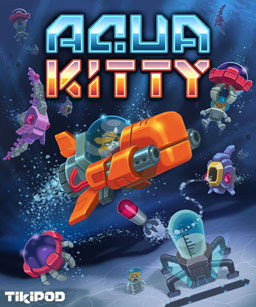
Aqua Kitty – Milk Mine Defender

A game by Tikipod for PC, PS4, Vita, Xbox 360, Xbox One, and Switch, originally released in 2012, with the UDX version released in 2017.
Aqua Kitty – Milk Mine Defender is a shooter that mixes Defender, In the Hunt, and a fresh bag of cats in a game that has you defending underwater feline milk miners from an army of robotic fish and other mechanical monsters. This is a game that pads its litter box with ripped up pages from the dictionary carrying the definition of the word “serious”.

In the future, a sudden milk shortage forces the cats of the world to seek out a new source of their favorite lactose-infused beverage. Strangely, huge untapped reserves of milk were discovered deep beneath the surface of the ocean, requiring that the cats overcome their natural fear of water to begin a drilling operation.

A pipe-smoking kitty captain mans the ship that acts as your base of operations, and he briefs you before each mission about the dangers ahead, often providing information about the types of enemies you’ll be facing. You play the part of an eye patch-wearing submarine pilot who must go it alone, or team up with a pussy pal in offline co-op, to keep the milky operation in the white.

The core gameplay is reminiscent of Williams’ classic arcade hit Defender in that there are numerous mining stations at the base of the ocean floor, and certain enemy types – red submarines in this case – descend slowly to abduct the adorable milk miners and carry them away. Shooting down the submarines before they breach the water’s surface allows the kitties (who are fortunately immune to your bullets) to fall safely back to the ground.


Centipede vs. Bad Caterpillar

2D VERSUS FEATURE
Bad Caterpillar is a game by Fun Infused Games for PC, Xbox 360, Ouya, iOS, and Android, originally released in 2013. Centipede is a game by Atari for the arcade, originally released in 1981.
Atari’s Centipede was one of the most iconic games of early 80’s arcade gaming. In this era, an arcade machine’s physical design and attract mode essentially played the part of the carnival barker, offering hints as to the amazing things that lay beyond the opaque curtain (“Step right up! See the amazing Centipede! Cut it in half, and it just keeps coming! Only 25 cents, folks!”).


Centipede lured players in with its amazing cabinet art, unique visuals and audio, and its use of a trackball as its primary control input – one of the first arcade games to do this. The unique mechanics, environmental interaction, visual progression indicators, and tension-driven gameplay kept players coming back to sustain the centipede on its diet of precious quarters.

As is typical of arcade game design, the game starts out slow and escalates very quickly, offering a balance of engaging gameplay and frequent death, tempting the player to drop in another coin when his stock of lives is depleted. The player character sits at the lower end of a mushroom field, and the player is able to move around in a confined area at the bottom of the screen and shoot upward. At the top of the screen, your multi-legged foe moves back and forth, dropping one level downward and reversing direction when it touches a mushroom or the edge of the screen, steadily descending on your position.

You must fire upward at the centipede, but hitting it in the middle causes one segment to be destroyed – and replaced by a mushroom – while the centipede splits at that point, sending one part onward and the other part backward, making it an even tougher target. For each section of the centipede you destroy, a new mushroom is added to the playfield. And the more mushrooms there are, the faster the centipede is able to move downward.


Bleed

A game by Bootdisk Revolution for PC, Xbox 360, Xbox One, PS4, and Switch, originally released in 2012.
The year 20XX was a time of many great heroes whose deeds have been celebrated in the years since, and a museum has been erected in their honor. But now, 100 years later in the year 21XX, no new heroes have emerged, and the old heroes only revel in their past glories, with some of them using their positions to take advantage of the people. One young woman, Wryn, has had quite enough of this, and she creates a death list, writing on it the names of the 6 greatest heroes in the world. She plans to kill them all and show the world what a true hero is!

Wryn’s moveset is small but effective. She can move and aim independently, perform a 2x jump, a wall jump, and perform up to 3 midair dashes in any direction, making her quite effective at aerial combat. The use of air dashes all but nullifies the need for a wall jump, and the move can actually be disabled in the menu for air dashing purists. Wryn begins the game equipped with 2 weapons: the fast-firing dual pistols and the slow but powerful rockets, and the player can toggle between these weapons at will. A shop system allows the player to purchase additional weapons and upgrades based on his in-level performance (more on this in a bit).


City Tuesday

A game by Return to Adventure Mountain for Xbox 360, originally released in 2012.
City Tuesday is a somewhat experimental title involving time travel, bomb disposal, and the humor and mundanity of a city’s hapless citizens as they go about their daily lives. The game is presented in an interesting graphical style built entirely upon infographics, those generally wordless pictographs that give directions or explain how to avoid serious injury through improper escalator usage and suchlike.

As the game begins, the player finds that time has stopped, and everyone appears to be stuck in the midst of their regular lives, mid-step on a walk through the park, frozen while tending to their daily routines, and even paused mid-fall as they slip on a wet floor. The world is presented in greyscale, while the protagonist’s shirt appears in red, and a few key interactibles are highlighted with colored icons.

Of course, while the world is stopped, the protagonist is able to move freely. Controls are limited, and the player may only move to the left and right, ascend and descend escalators, and perform a low 1x jump (which isn’t actually required for the bulk of the game). The player may also open a subway-style map that shows the general layout of the game world, with each of its single-screen environments presented as a node, and connectors showing where paths branch.

As the player moves through the paused cityscape, he eventually comes to a door that allows him access to a museum. Upon entering the door, the player informed that he has 1 minute before the bombs will go off. Time is now running normally, and the player must move from one screen to the next to collect each bomb before time runs out.


Ninja Exorcist

A game by Nebula Game Studios for Xbox 360, originally released in 2012.
Ninja Exorcist: Episode 1 is a stealth action game with RPG elements starring a ninja named Daigo who must uncover his forgotten past and kill a load of bad guys and monsters while doing it. The game offers a number of interesting design concepts, but struggles a bit in seeing them executed to support the greater ninja experience.

Our ninja hero begins his quest with a sword and a number of combo attacks that are initiated by tapping the ATTACK button. Combos can extend to a maximum of 4 hits, but the player is free to interrupt them at any time. In addition to straightforward attacks, the player may also press diagonally up or down to execute high and low attacks and string them together into combos as well. The player is able to mix high, medium, and low attacks in any combination he wishes and use them in the air as well. The ninja can also knock enemies backward with his attacks, sending them into other enemies or tumbling off of ledges where they will resume fighting on a lower platform, or die painfully in a bed of spikes.


Slick

A game by Halcyon Softworks for PC and Xbox 360, originally released in 2012.
Slick is a game that you may not be able to complete, but the same can also be said for any number of 8-bit platformers that this game takes after. In both design and appearance, the game is modeled after a greyscale GameBoy title, except with much higher resolution, widescreen display, and no blur, similar to Ishisoft’s Treasure Treasure: Fortress Forage: Extra Edition.

The basic gameplay is simple, with only a directional stick and JUMP button at your disposal, but your mastery of these basic mechanics is constantly challenged across the game’s 100 levels. The difficulty curve is gradual, but its apex is high, requiring the firm application of old school skills, or at least the tenacity to stick with the game until you have acquired them.

Things start out very simply. World 1-1 is reminiscent of World 1-3 in Super Mario Bros., with floating blocks over bottomless pits, turtle-like enemies patrolling left and right, and (non-interactive) plateaus on sticks sitting in the background. The player is equipped with a higher than average 3x non-variable jump, and nothing else. No new skills are learned during the adventure, and most of what you need to know about the game occurs in the first few levels.


Go Gimbal Go

A game by Gimbal Lock Studios for Xbox 360, originally released in 2012.
Rainbow Island is an idyllic world populated entirely by children. Rather than bashing each other’s heads in with rocks, they spend their days playing and running about on the beaches and forests, and also conducting some sort of business in their cities. But the evil King Commandroid has invaded the land, imprisoned the children, and drained the magic from the colorful rainbow pathways in the sky. Things seem pretty bleak until a little girl named Alice writes a letter asking for help, folds it into a paper airplane, and tosses it out the window. Suddenly, a little purple ball named Gimbal appears, piloting his Star Rider ship down from the reaches of space to help the poor children of Rainbow Island. Despite the deliberately silly premise and the cutesy art style, Go Gimbal Go is no simple game, and poses some serious challenge even for grizzled gaming veterans.

The game begins with an introduction of the basic mechanics. Most of the time, Gimbal will be travelling down rails, with plain white rails allowing him to move at normal speed and rainbow-colored rails allowing him to boost along very quickly. When the player mashes the RIGHT TRIGGER, Gimbal speeds up (you’ll be holding this button down for most of the game), and letting off the trigger slows Gimbal down. Hitting the LEFT TRIGGER acts as a brake, which can be useful in later levels when attempting to avoid obstacles.


Apple Jack 2

A game by My Owl Software for PC and Xbox 360, originally released in 2012.
In the original Apple Jack, the titular hero – a guy with an apple for a head – treks across the UK in search of his missing dog, contending with numerous pandas and agitated washing machines along the way. But since his grand cross-country adventure, Jack’s life has become a bit droll. He works in a sterile little office at a plastics company, sitting bored at his computer and missing the days of adventure that seem well behind him. But then, inspiration strikes. He walks into the middle of the office, strips naked (minus his tie, shoes, and socks), crashes through the window, and runs out into the rolling hills beyond. And so the new adventure begins with a nearly naked Apple Jack heading off to enjoy a day at the beach.

Hardcore apple-man nudity aside, much of the game will be very familiar to fans of the original. Apple Jack has a 2x variable height jump, a wall slide, and a wall jump. He also has a slow midair direction change similar to our favorite platforming plumber from Super Mario Bros., and the ability to duck down and roll through small spaces (rolling just his apple head) similar our favorite bounty hunter heroine’s morph ball from the Metroid series.


Compromised

A game by Super Soul for PC and Xbox 360, originally released in 2012.
In Compromised, you take on the role of Aero, a defensive ship tasked with fighting off an invading virus that threatens to destroy everything. You travel into outlying areas to stop the virus before it can reach the core, but you are soon cut off, stranded in the wastelands and unable to receive any new directives. Alone and outnumbered, you attempt to fight your way back home.

While Compromised has a twin-stick control scheme, it is not a twin-stick shooter in the traditional sense. The one area where the game adheres to twin-stick conventions is in confining the player in a number closed arenas where he must circle strafe his enemies, face off against multiple waves, and manage large numbers of incoming forces that each have their own set of behaviors and attack types. These environments range from cramped spaces to large multi-screen areas where it’s possible to outrun your enemies altogether and turn to make a stand.


SEAL Team 12

A game by Social Loner Studios for PC and Xbox 360, originally released in 2012.
SEAL Team 12 is a top-down shooter that harkens back to the glory days of arcade titles like Ikari Warriors and Commando where players fought their way through enemy territory, vastly outnumbered, but fortunately not outgunned. As is standard in the overhead shooter genre, players take control of a one man army (or a two man army in local co-op) and fight waves upon waves of enemies as they march through various jungles, fortresses, and enemy encampments. Along the way, players can grab more powerful weapons – and even enemy tanks – to unleash greater firepower upon their foes.

The game starts off with a bang, introducing players to the world of over-the-top action and humor that awaits them. In the opening cutscene, a lone silhouetted soldier stands surrounded by innumerable foes, and what does he do? He puts on his best rage face and spins around blasting each of the baddies to bits. Soon, the player is introduced to an enemy force known as the Guardians of Devastation, a.k.a. GOD. Who is GOD? What are GOD’s plans? Where is GOD getting the stockpile of free socks that it hands out to new recruits? These are the answers put forth to SEAL Team 12 at the start of the game. To find the answer, you’ll need to shoot every damn thing you see across 13 levels until you face off against GOD’s war machine.


Pendulous

A game by Do Better Games for Xbox 360 and WP7, originally released in 2012.
Like many puzzle-oriented games, the action in Pendulous starts out very simply, building slowly and introducing new obstacles and challenges along the way. At first, you’ll just be learning how to deal with pendulum motion, swinging your orb back and forth and then disconnecting to send yourself sailing through the air to the next grapple point as you make your way toward the goal. Eventually, you’ll need to string together multiple successful swings while avoiding obstacles, activating switches, and using the environment to your advantage.

At the outset, a tutorial level and 7 additional levels are open, which may be selected in any order. The escalation of difficulty is gradual from one stage to the next, so it’s best to complete them in sequence unless you’re having difficulties and wish to skip past a certain level. Eventually you’ll open up levels 8-14, as well as a hard mode. The hard mode sends you into mirror versions of the regular levels without any checkpoints, so this is reserved for players wishing to truly challenge their skills.


Explosionade / Explosionade DX

A game by Mommy's Best Games for PC, Xbox 360, Switch, PS4, PS5, and Xbox One, originally released in 2010, with the DX version released in 2021.
Explosionade - and the expanded Explosionade DX - falls into the 2D mech combat sub-genre, taking its inspirations from games like Cybernator, Metal Warriors, and Assault Suit Leynos. In these games, the player takes control of a huge mech that is represented onscreen by a relatively small sprite, but which has huge amounts of firepower. Navigation tends to be a bit slow and deliberate, with a focus on pressing forward, defending your position, and choking your enemies with mouthfuls of bullets, missiles, bombs, and whatever else you have stashed away in your arsenal. And, in Explosionade, you can double the firepower in local 2P co-op. Before we get any further, you may want to learn more about our secret and terrible Hidden Agenda. Or don’t. You can’t stop the apocalypse anyway…


Super Ninja Warrior Extreme

A game by Ho-Hum Games for PC and Xbox 360, originally released in 2012.
While Super Ninja Warrior Extreme has an objectively incredible title that would have practically guaranteed its success in the 16-bit days, it smacks of a cheap cash-in when placed amongst the glut of moderate- to low-quality ninja-themed games available in the downloadable space. All the more pleasantly surprising, then, is the fact that the game offers the solid mechanics, chunky presentation, and old-school thrills you might expect from the consoles of yore.

Super Ninja Warrior Extreme falls into the same category as Aban Hawkins & the 1000 Spikes in that it has a chunky art style, simple enemies, a small number of moves, and short levels. On its own, there’s nothing terribly special about any of these things, but the overall presentation, level structure, and unforgiving-yet-rewarding 1-hit kill gameplay make all the difference.

Here, the player takes on the role of a ninja as he travels through 30 short levels killing bad guys, dodging projectiles, and riding platforms to victory. The ninja has a variable height jump that maxes out at 3x, allowing for some high-flying action, but also a great deal of precision, as the player can readily adjust anywhere between a 0.5x jump and 3x. In early levels, this added control is a nicety, but not a necessity. But about 2/3 of the way into the game, mastery of variable jump heights is required for success. As with any ninja worth his katana, the character can wall jump, wall slide, and climb up vertical surfaces by performing multiple wall jumps.


Growing Pains

A game by Smudged Cat Games for PC and Xbox 360, originally released in 2011.
There aren’t many developers who can claim to have been inspired to make a game based on the size of their wives (at least not many who have survived to tell the tale), but that’s precisely what developer David Johnston did. As he watched his pregnant wife grow bigger and bigger, he began to think of her growth in video game terms… How would you deal with a platforming world if you played a character who couldn’t stop growing? That question is answered with Growing Pains.

A 3D world is a perfect place to explore scale since the very nature of 3D allows for the creation of objects of any size. However, few titles have actually explored scale in any meaningful way. Noteworthy applications of gameplay-impactful scale are the Chibi Robo games, the Remote Control Dandy / Robot Alchemic Drive series, and the God of War series. Even fewer games explore physical growth as a gameplay dynamic, with the Katamari Damacy series being the standout example.


Wizorb

A game by Tribute Games for PC, Mac, Linux, PS3, Vita, Xbox 360, Ouya, iOS, and Switch, originally released in 2011.
Brick breaking became its own genre with the 1976 arcade release of Breakout, created in the earliest days of what would eventually become known as the video game industry. As with all great successes of the day, the game went on to be cloned and copied and iterated upon many times over. Years later, a game based upon this formula – called Arkanoid – surpassed the original by adding new types of bricks, variable brick formations, and powerup capsules.

Brick breaking gameplay has persisted throughout the generations with numerous variations on the formula. What’s interesting about these games from a design perspective is that they each require direct and nearly constant input from the player, yet the player is not in direct control of the primary gameplay object (the ball) for most of the game. Direct interaction occurs less than 10% of the time and the outcomes of these interactions are impossible to precisely predict.

In this way, the descendants of Breakout are more akin to a form of video pinball, where the player spends most of his time strategizing and attempting to line up a productive shot, while spending the remainder preparing to react to the game’s machinations.


Escape Goat

A game by MagicalTimeBean for PC, Xbox 360, and Switch, originally released in 2011.
Escape Goat is a puzzle-platformer that stars an unlikely hero – namely a purple goat who has been imprisoned for the crime of witchcraft – and his unlikelier companion, a mouse that can run up walls. The duo must use their heads, literally and figuratively, to make their way through dozens of challenging single-screen dungeons on a quest to rescue a batch of fluffy sheep and escape the clutches of their captors.


Dead Pixels

A game by CSR Studios for PC and Xbox 360, originally released in 2011.
The title Dead Pixels: An 8-Bit Zombie Sim borders on the artful in terms of its descriptiveness of the core gameplay. The game features an 8-bit art style with character sprites reminiscent of the 8-bit Mega Man games. The main character faces off against hordes of the undead in a street-by-street battle to safety. But unlike a straightforward action game, you must manage your supplies, acquire money, and purchase upgrades if you hope to survive.

One of the key elements to level progression in Dead Pixels is the ability to collect coins from fallen zombies, raid abandoned buildings for supplies, and make purchases and sales in shops. This design immediately lends itself to comparisons with the River City Ransom games, although in reality, it is more along the lines of Scott Pilgrim vs. the World: The Game (which is itself inspired by RCR), given that level progression is entirely linear.